
Once again, the bonkers story of how organ transplant patients aquire the behavioural characteristics of their donors has cropped up in the more gullible papers. So, i thought I would bump up this post.
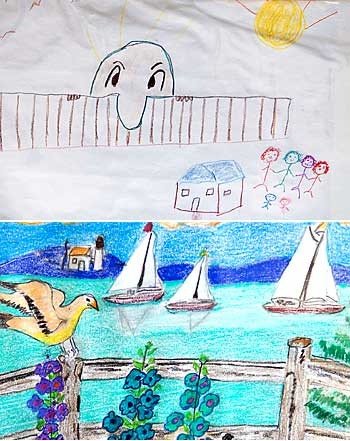 Here’s a story from the Daily Mail. A man gains a miraculous ability to paint after receiving a heart transplant from an artist! Let’s see what the quackometer makes of it…
0 quack points
Not too good then. Could this be real? Maybe some manual debunking is required after all.
What is being claimed here is that every cell in the body has some sort of ‘soul’ that can take ‘memories’ with it between donor and recipient – a sort of 21st Century Lamarkism.
So let’s look at Mr Sheridan’s new amazing ability to draw, before and after…
Well, looking at the pictures above, it appears that our patient has mastered the artistic skill of ‘colouring in’. If you were particularly generous, you could say he even has got to the level where he stays within the lines. Hardly, the next Turner, Constable or even Damien Hurst. I was half expecting the report to say that after he left his hospital bed in a dishevelled state, it was derivative of the work of Tracy Emin.
Imagine the news story…
Art critics have been quick to dismiss heart-transplant patient, William Sheridan’s, naïve art sketches of birds and boats, but after he has recently moved into installation pieces, the art-world has suddenly looked up. Said Dr Schwarz, “After Mr Sheridan left hospital, a Resident Consultant noticed he had left behind his greatest masterpiece yet.”
Although highly derivative of the work of English artist, Tracy Emin, there is no way that Mr Sheridan could have produced such work before his heart transplant. Entitled “My Bed”, the work is an installation consisting of rumpled sheets, lucozade bottles, discarded grape stalks, latex gloves and blood stained hospital gowns.
Jeannette Winterson said “This is the detritus of a life quintessentially his own; it was, above all, confessional.”
Dr Schwarz commented that “this mise en scène was proof of every cells interconnectedness and that ‘cellular memory’ has been contextualised within an aesthetic of dirt and disgust.” He added, ‘We are just hoping that his next effort is not derivative of Emin’s work “Every Part of Me’s Bleeding”.’
Charles Saatchi has denied rumours that he has expressed an
interest in buying the work.
Mmmm. A heart transplant patient. Extra time on his hands. Maybe a desire to try new things. I think that is all the explanation we require to explain our new art talent. So where did this story come from and why did the Mail publish it?
A little more digging reveals that Dr Schwartz is well known to quackbusters. Dr Gary Schwartz heads up the Veritas programme at the University of Arizona. Veritas “was created primarily to test the hypothesis that the consciousness (or identity) of a person survives physical death”. Ahh! real life Ghostbusters.
I guess if you can ‘prove’ that your ‘identity’ can survive a heart transplant, then you are half-way to ‘proving’ that it could survive death. Well, in their minds perhaps. If this is the case, I am a little disappointed that the best-evidence so far for life after death is a hastily crayoned drawing of a seagull. (At least, I think it is a seagull.) I was hoping for better.
You can nominate Mr Sheridan for the Turner prize here.
Hey Black Duck! Followed you over from “Bad Science”. Maybe these people used to be fans of the Adverts back in 1977/8 (remeber their song, Gary Gilmore’s Eyes)?
Heart transplant cellular memory is an oxymoron.No such process takes place during heart transplant. I was a cardiac transplant recipient six years ago and I cannot play the piano now nor could I play before the transplant.These patients claiming cellular memory are attempting to claim their fifteen minutes of fame by attributing their delusions to an organ transplant.
michael thomas
http//my-heart-transplant-blog.blogspot.com
An observation from my experience:
The last time I checked UNOS stats, generally 75% of heart recipients (not true of other organs) are males, 25% are female. In addition, most of the transplant cardiologists and surgeons are men. I have found that men are uncomfortable with the idea of accepting someone else (heart, spirit or piece of meat- however you view your donor heart) into their bodies and their being. Simpler put: receptivity is not easy for men. So it does not surprise me that so many male recipients are vocal in their ridicule of what makes them feel vulnerable and uncomfortable by its nature. Moreover, I have found that when I speak with male recipients alone and not surrounded by men in the support groups (which are dominated by men because of the percentages in the heart tx world), I hear very different comments. I consider this buckling to peer pressure similar to a locker room effect.
Extrapolating from your single experience to all heart recipients is meaningless, yet this often happens relative to this topic. I rarely, for example, take immuno-suppressant meds (I am 15 years out from transplant). Should I generalize from my experience and tell you that you should also quit taking yours? And ridicule you for taking them or for not having a similar experience to mine?
Lastly, I heard one female recipient, whom I think was from Arizona, make similar comments to yours, but I have heard many men across three transplant centers succumb to the peer pressure I described above and go into hiding about their feelings and about many of the personal, social, financial and spiritual aspects of living this life. Particularly the level of depression that characterizes life for many recipients.
All you can conclude is that you have no changes (personality, food preference, etc.) since your transplant that you cannot account for. That fact that you can’t play piano — before or since — lends nothing to the overall discussion except to diminish others’ experiences, Michael.
It occurs to me that the female recipient I once heard speak with a similar dismissive tone about this topic used the same phrase you have to trivialize others’ experiences — i.e., “attempting to claim their fifteen minutes of fame…”
Try a new thought and open your heart in the process.
Catherine Beckman
Colorado Springs, CO, 10/3/2007
kind of goes along with the theory of souls “on the other side” contacting us. unless there is a extreme reason for doing so; revenge, need to give forgiveness, tell something, need to finish something, or violent situation (does not have to be death), then they probably will NOT contact us or any transference to us.
now I can’t speak much for this, but im sure there aren’t a lot of people who are donors who had one of the above to a extreme degree.
(drunk drivers, druggies, accidental death, suicide, possible murder, *NEED NOT APPLY*)
point is, there may be very few (1of billions) that would be of the right circumstances for this to occur, both the donor and the recipient need to be “compatible” and accepting to the “transfer”
so even if this IS possible, is rare that it would occur & and be noticed. and if you are against it , it won’t occur.
There have been discoveries of brain cells and an entire neural system surrounding the heart. Why is it so difficult as a scientist to look at this and say, “Maybe we don’t understand this entirely” ? The opposite of that, of course, is that maybe we do understand…. Being dismissive and condescending is the polar opposite of being scientific, however.
Some people that believe in cellular memory may believe in “cellular souls” but to profess all believe it is beyond reductionist. Its a fallacy.
Also, I’m in agreement with the commenter who said extrapolating from personal experience and applying it to a whole is a dangerous and completely unproductive process.
This heart transplant cellular memory thing made me wonder if the idea had surfaced in a short story written by Stephen King. Or should I have been thinking about a Superman comic?
Anyway, Andy, that potential news story fragment is superb! Thanks for those laughs. I used to work at an art college. And Jeanette Winterson lives too damn close to here for my sanity.
Well, you were proven wrong. Guess you haven’t seen the latest studies that the heart, along with other major organs do have “memory” neurons. That they are somewhat different than memory cells of the brain, but do in fact control and aid in the ability to control desires. The earth is round? No way…. You are a buffoon.
reference please…
I wonder how that works when surgeons doing transplants have been failing to connect up all those special ‘memory’ neurons.
I suspect my buffoonery is not quite yet proven.
Cells can have memory: http://www.nature.com/news/2008/080123/full/451385a.html
Cellular memory maybe a far fetched hypothesis but to completely disregard and mock it is not scientific at all. Surely its worth investigating.
Well said catherine. Those who mock others for relaying their own experiences after a transplant are just stuck in the stone ages! Their the same type of people who would have sworn the world is still flat! It could be possible that the guy who claimed he felt no change after a heart translplant, possibly inherited the energy signatures of someone who was a skeptical gormless twat! Oh the irony you can’t make this stuff up!
Well said catherine. Those who mock others for relaying their own experiences after a transplant are just stuck in the stone ages! Their the same type of people who would have sworn the world is still flat! It could be possible that the guy who claimed he felt no change after a heart translplant, possibly inherited the energy signatures of someone who was a skeptical gormless t***! Oh the irony you can’t make this stuff up!
I’m a heart receipant of 4 years…How dear you criticize what you don’t know and have not experience.NO one goes around Lookin for stuff,We just want to live our lives again,and Happy for a second chance!Cellular Memory is true & so is Out-of-the-Body Xperiences.Look for my Book in pre-publication,Healed Beyond The Symptoms.
To everyone who actually said that they believe ”cellular memory” is somehow possible…
How in the Hell do you idiots actually try to justify something as insignifagant as a cell retaining the physical memory of being shocked or treated terribly by said cell’s owning person by years of alcohol abuse, with something as complex as the higher intelligence possessed by the human brain, only functioning because of hundreds of trillions of connections which link them all together?
Just because I may drink more, therefore giving the cells of my liver a better notion of how to process alcohol, it most certainly wouldn’t translate to and transfer into another human having my fuzzy memories of drunken brawls and chance hookups on Friday nights!
You are all fools!!
What about people who receive pig heart valve transplants? Do they have the urge to go out in the woods and root for truffles?