
Le Canard Noir is currently working on a site revamp and this will now include a shopping area for all your favourite quackometer products. You have already had a sneak preview of the t-shirt range.
Now, I can give you a teaser for the range of compulsory site mugs….
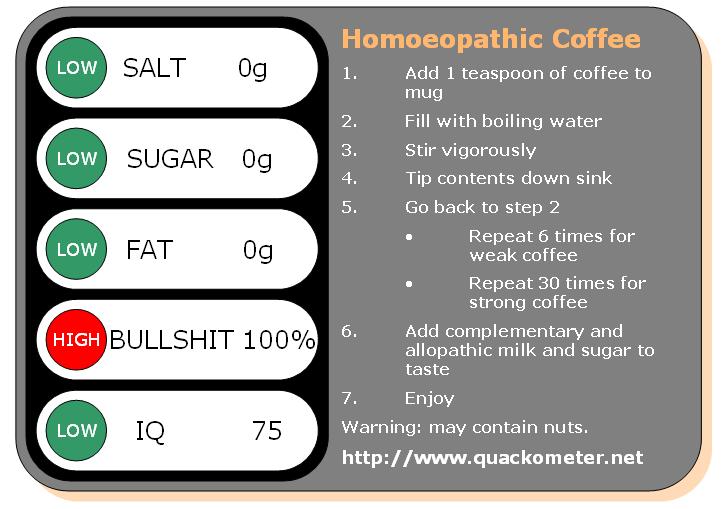
ah, but surely you’d have to start with something that had the opposite effect of coffee for this to be true homeopathic coffee – that’s just a cure for insomnia you’ve got there
I love this mug, I want one, how do I get one? and a t-shirt too, size L please.
btw, what does the quackometer say about Dr Sherry Rogers and her ‘far infra red’ detoxifying saunas?
I too would buy a homeopathic coffee mug (er, is it really there, or is it just a teensy weensy speck within the universe) – but can i suggest two versions – mine would have to have the polite version of b******t on it for professional purposes….
WHY NOT SELL THIS BOOK AS WELL???
Certainly one story that needs to be told is that of Dr. Kanematsu Sugiura. In 1975, Dr. Sugiura was, and had been for some years, one of the most respected cancer research scientists at Sloan-Kettering. In working with cancerous mice, Dr. Sugiura found that, when he used Laetrile on these mice, seventy-seven per cent of them did not develop a spread of their disease (metastatic carcinoma). He repeated this study over and over for two years. The results were always the same. Dr. Sugiura took his findings to his superiors at Sloan-Kettering, but his study was never published. Instead, Sloan-Kettering published the results of someone else who claimed that he had used Dr. Sugiura’s protocol. This “someone else’s” study showed that there were no beneficial effects from the use of Laetrile. Dr. Sugiura complained. He was fired. A book was written about all of this entitled The Anatomy of A Cover-up. This book has all the actual results of Dr. Sugiura’s work. These results do, indeed, show the benefit of Laetrile. Dr. Sugiura stated in this book, “It is still my belief that Amygdalin cures metastases.” Amygdalin is, of course, the scientific name for Laetrile
This would be great on a coffee mug
Within a two-year period Harry Hoxsey was arrested about 200 times for practicing medicine without a licence. The brother of the district attorney who initiated these arrests had advanced cancer. Unbeknown to his lawyer brother, he went to Hoxsey and was cured. On learning about this, the district attorney quit his job and became the defence lawyer of Harry Hoxsey.
Harry Hoxsey was the most famous herbal cancer therapist in the US. He had clinics in various states, and thousands of satisfied patients attested to the effectiveness of his herbs. Despite being arrested more often than any other therapist for practicing medicine without a license, the courts confirmed the therapeutic value of his herb mixture and even the AMA reluctantly admitted that some of his remedies had merit.
here’s another for your mug collection
“In large measure, those martyred by dementia are showing the results of toxicity from mercury, aluminum, lead, cadmium, arsenic and other heavy metals. Their neurons have been poisoned. They are turned into Alzheimer’s victims directly through the efforts of dentists who blindly follow the party line of their trade union organisation, the [American Dental Association].”
Dr Casdorph, M.D.
a few more suggestions
Medication Errors
A survey of a 1992 national pharmacy database found a total of 429,827 medication errors from 1,081 hospitals. Medication errors occurred in 5.22 percent of patients admitted to these hospitals each year. The authors concluded that a minimum of 90,895 patients annually were harmed by medication errors in the country as a whole.37
A 2002 study shows that 20 percent of hospital medications for patients had dosage mistakes. Nearly 40 percent of these errors were considered potentially harmful to the patient. In a typical 300-patient hospital the number of errors per day were 40.38
Problems involving patients’ medications were even higher the following year. The error rate intercepted by pharmacists in this study was 24 percent, making the potential minimum number of patients harmed by prescription drugs 417,908.39
Recent Adverse Drug Reactions
More recent studies on adverse drug reactions show that the figures from 1994 (published in Lazarou’s 1998 JAMA article) may be increasing. A 2003 study followed 400 patients after discharge from a tertiary care hospital (hospital care that requires highly specialized skills, technology or support services). Seventy-six patients (19 percent) had adverse events. Adverse drug events were the most common at 66 percent. The next most common events were procedure-related injuries at 17 percent.40
In a NEJM study an alarming one-in-four patients suffered observable side effects from the more than 3.34 billion prescription drugs filled in 2002.41 One of the doctors who produced the study was interviewed by Reuters and commented that, “With these 10-minute appointments, it’s hard for the doctor to get into whether the symptoms are bothering the patients.”42 William Tierney, who editorialized on the NEJM study, said ” … given the increasing number of powerful drugs available to care for the aging population, the problem will only get worse.”
The drugs with the worst record of side effects were the SSRIs, the NSAIDs, and calcium-channel blockers. Reuters also reported that prior research has suggested that nearly five percent of hospital admissions–over 1 million per year–are the result of drug side effects. But most of the cases are not documented as such. The study found one of the reasons for this failure: in nearly two-thirds of the cases, doctors couldn’t diagnose drug side effects or the side effects persisted because the doctor failed to heed the warning signs.
Treating and curing symptoms but never understanding the root cause of the problem. Prescribing drugs that have more side effects than you can count on both hands and feet, along with the fact that they kill people. This is allopathy. However, when it comes to natural medicine, they’ll tell you not to take certain herbs if you are on blood thinners because it will thin your blood that much more, BUT..they don’t work at all when you discuss just taking them and not the money making medicine. And God forbid one person gets nauseous from a botanical, it is made into world wide news. This is insanity at its finest.
I wonder…when all powers in the universe came together over time to make man, where was the synthetic drugs? I didn’t see any either, BUT I did see the plants which Big Pharma gets all their ingredients from. Thank God for Big Pharma, really putting some value into these worthless plants.
Use of the term “allopathy” marks you as an apologist for quackery. “Allopathy” is a derogatory term that a quack called Sam Hahnemann made up to describe the orthodox medicine of his day (which was, admittidly, pretty much useless at best). That was over 200 years ago, and modern medicine bears no resemblance to any medicine of Hahnemann’s time. Since CAM ignores evidence, and therefore has no way of eliminating useless treatments (homoeopathy is the prime example of this) most forms of CAM are basically fossilised mistakes, with practitioners stuck in obsolete paradigms. It is not particularly surprising that CAMsters have not noticed the last 200 years of medical and scientific progress.
Actually, “treating symptoms but never understanding the root cause of the problem” is an almost perfect description of homoeopathy. It considers nothing but symptoms, and (because it was invented before germ theory, genetics, the discovery of basic biochemical principles, or even atomc theory) has no idea about causes of disease. Indeed Hahnemann specifically states in the first aphorism of the Organon that causes of disease should not be considered.
Mojo… You decided to go for this one did you? I ummed and aaahed. Well, in for a penny, in for a pound as the saying goes.
Fooch, I’m not quite sure what point you are trying to make. Scientists know that many herbs contain powerful physiologically active substances and of these have formed the basis for several modern drugs (think of aspirin, artemisinin, quinine to name but a few). Where botanicals are shown to be effective, the active components are investigated and utilised, as you point out in you final paragraph (thus contradicting your main point which I think is the undervaluation of ‘natural medicine’, by which I think you mean herbs).
Herbs also have side-effects of course (and can kill):
http://en.wikipedia.org/wiki/List_of_herbs_with_known_adverse_effects
Also, you can slate allopathy as much as you like because I don’t know if there actually are any allopaths. Modern medical science is chiefly focussed on finding the root causes of diseases. It bears no resemblance to this ‘allopathy’ you allude to. Some drugs are for treating symptoms, some for tackling the cause of the disease.
Also, what link is there between herbal medicine (the very loosely evidence-based prescription of herbs and herb products) and homoeopathy (the evidence eschewing prescription of water drops and sugar pills, which is in no way ‘natural medicine’)?
So, in summary, you make wildly false claims about modern medical science; try to knock down the ‘straw man’ of allopathy; and make conflicting points about the undervaluation of botanicals despite the fact that many modern treatments originate from herbs.
Want to try again?
“…I don’t know if there actually are any allopaths.”
Yes, there are. They practice an alternative medicine called “Unani” which is essentially the Hippocratic/Galenic medicine, based on the concept of the four humours, which mainstream European medicine was still based on in Hahnemann’s time.
So THAT’S who Fooch was digging at. Good knowledge.
Go for it Fooch, you get those allopaths.