
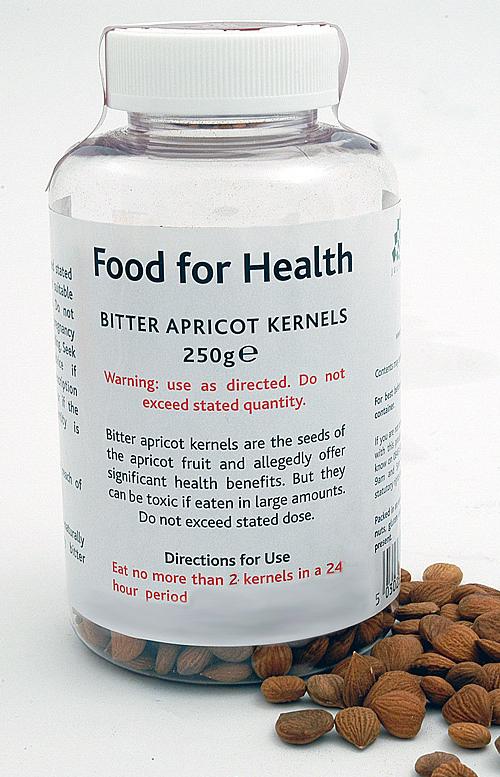
 So. Today. I had a quite jaw dropping conversation in my local branch of Julian Graves. For my American readers, Julian Graves is a shop that sells large bags of nuts, seeds, dried fruit, food ingredients and confectionery. I quite like them. Low on packaging, low on branding, and excellent value for money for kitchen basics. And they are not too puritanical in their outlook. You can buy enough liquorice allsorts, for a couple of pounds, to make a family of six sick.
But passing their window, I see a big stack of jars (pictured left) on offer at half price for £3.49, containing a quarter of a kilogram of bitter apricot kernels. The label contains a dire warning not to eat more than 2 in 24 hours. How odd! Now, some spices are not good for you if you eat large amounts: nutmeg springs to mind. But these kernels are not a spice. What are they selling this for? It hardly looks edible to me.
So, I walk in and as the shop assistant what these bitter apricot kernels were for. She responded straight away, “They are good for some sorts of cancer”. OMFG!
Is that all? Apparently, yes. They are not food – they are far too bitter to eat. What is more, the disclaimer is there because they produce amounts of cyanide when eaten. Eat too many at one go and it will be your last visit to Julian Graves and that is not too good for repeat sales.
I am not too sure about the legality of this conversation. The Cancer Act of 1939 says “No person shall take any part in the publication of any advertisement containing an offer to treat any person for cancer, or to prescribe any remedy therefor, or to give any advice in connection with the treatment thereof.” As this was a conversation, maybe it falls outside this act. I return home and check on the Julian Graves website about what they say. It is worth repeating their page in full…
You have been requesting them in your hundreds and now they are available online and in stores.
We are the first UK retailer to sell this controversial product which many people believe may offer significant health benefits.
The kernels, seeds of the apricot fruit, are one of the highest sources of vitamin B17 – also known as laetrile -which, it is alleged, may help protect the immune system.
But the kernels have a very bitter aftertaste and can be toxic if eaten in large amounts. Yet, as more data becomes available – particularly on the net – about the benefits of vitamin B17, people will probably be willing to accept the bitter taste in the belief that these kernels may help maintain their health.
But it’s important to stress that – to date – no medical or scientific research has been carried out on the kernels so their ‘perceived’ benefits cannot be proven in any way.
As a responsible retailer, we do not make any claims about the product’s ‘alleged’ powers. All we can do is make them available and ensure the potential problem of eating too many in one go is highlighted.
We strongly recommend that if people want to know more about bitter apricot kernels and vitamin B17, they should go online and do their own research.
They end with the statement,
If you firmly believe in the power of bitter apricot kernels, we would love to hear from you. Please email us at [email protected]
Staggering stuff.
Where do we start? The most obvious thing is that there is no such thing as vitamin B17. A vitamin is a nutrient that the body requires in tiny amounts. B17 is sometimes called laetrile. This compound was called Vitamin B17 by an Ernst T. Krebs who claimed it was a vitamin, mostly so that it could be sold as a food supplement and avoid medicine laws. He claimed cancer was caused by a lack of ‘B17’. Laetrile is pretty big stuff in the USA with many alternative medicine hucksters offering it in one form another. The web is chockablock with misinformation and wild claims about the stuff. This makes the Julian Graves request to ” should go online and do their own research” pretty despicable.
What do reliable resources say about laetrile? The Cochrane Review says,
RESULTS: No RCTs or non-RCTs were found, so no abstraction of outcome data could be performed in this systematic review AUTHORS’ CONCLUSIONS: The claim that Laetrile has beneficial effects for cancer patients is not supported by data
from controlled clinical trials.
Bandolier at Oxford come to a similar conclusion,
The bottom line is that there is no conclusive evidence of efficacy, but considerable evidence of toxicity, especially that associated with cyanide poisoning.
Cancer Research UK give warnings to cancer sufferers,
Your doctor may tell you that there are no further conventional cancer treatments available that could cure your cancer. But treatments to control your symptoms are still possible. The news that your cancer can’t be cured is very difficult to accept. And in this situation, many people consider alternative therapies, including laetrile.
There isn’t enough proof that laetrile is an effective treatment for cancer or any other disease. Most of the websites promoting laetrile base their claims on unsupported opinions and anecdotal evidence.
Their web site is full of sensible advice on this quackery.
Julian Graves have previously got into trouble over selling apricot kernels. The Food Standards Agency stepped in previously to stop their sale as there was no warning that eating only a small handful could potentially be fatal. The Daily Mail reported,
The chain pulled them in line with FSA advice but would start selling them again with a revised dosage recommendation if the food watchdog gave it permission to do so.
Has the FSA allowed them to sell this dangerous and useless product? The product is not just dangerous because of the cyanide poisoning thing, but it allows desperate people to engage with dangerous web healing fantasies. There is no other use for this product and Julian Graves appears to be happy to assist.
A few weeks ago Julian Graves was acquired by American pharmaceutical company NBTY after troubled Icelandic conglomerate Baugur sold them on. Their CEO, Scott Rudolph, said,
The acquisition of Julian Graves is an integral part of NBTY’s strategic plan to enhance its position as the number one supplement retailer in the UK and gain geater market share. We continue to seek acquisitions which generate growth and further entrench NBTY as the worldwide leader in the nutritional supplement industry.
Julian Graves has not really been big on ‘health’ supplements up til now. NBTY already own Holland and Barrett and GNC in the UK. They dominate the industry of useless pills that trade of web rumours for their effectiveness. A few dayas ago I speculated they might be interested in troubled UK supplement pill pushers Neutrahealth. I think we can be expecting to see a lot more irresponsible supplement nonsense in the shop that used to sell chocolate covered banana chips.
*******************************************************************************
Follow up
We hear back from JG about how they justify the sale of this poisonous fruit food waste cancer quackery cure:
Julian Graves’ Mendacious Defence of Cancer Quackery
Northern Doctor writes about what eating apricot kernels can do to you.
Publicise, Publicise, Publicise!
And if they are contravening the Cancer act as well, I suspect the big boys like the MHRA would like to know
Idiots! The lot of you, (the comments here i mean, not the article)
Dire stuff. I’m with Value Added Water – rat them out to the MHRA, Trading Standards, and anyone else you can think of.
As you say, it is a shame to tarnish the reputation of perfectly useful products like chocolate-covered banana chips by selling them alongside this rubbish. Chocolate-covered banana chips perform a useful purpose, namely allowing me to eat chocolate while telling Mrs Dr Aust and Jr Aust that they are a healthy snack.
Laetrile, in contrast, is the grand-daddy of bogus “miracle natural cancer cures”. I am amazed it is still doing the rounds, as it was clearly labelled as quackery back in the 70s when I was still at school.
Proof, once again, that “No Woo Ever Dies”. Though sadly the same cannot be said of the poor sods that are talked into taking the stuff by some Alt.Reality con artist.
“But it’s important to stress that – to date – no medical or scientific research has been carried out on the kernels so their ‘perceived’ benefits cannot be proven in any way.
As a responsible retailer, we do not make any claims about the product’s ‘alleged’ powers.”
“Responsible retailer” meaning, presumably, one that is being careful to avoid doing anything that will get them into trouble with the MHRA or trading standards.
as well as squealing to the MHRA and TS, it may be worth contacting your local MP and getting them to flag this up in Parliament, evidently the Cancer Act needs to be better enforced.
as dr aust says, dire…
“…What is more, the disclaimer is there because they contain produce amounts of cyanide when eaten. Eat too many at one go and it will be your last visit to Julian Graves and that is not too good for repeat sales.”
Well, I suppose untimely death due to inadvertent cyanide poisoning is one way of avoiding cancer…
unbelievable.
Maybe the kernels could be passed on to Neutrahealth execs for disposal…
And I can anecdotally confirm the emetic efficacy of a bag of allsorts. So it must be true.
Heh – I remember reading a brightly-coloured woo webpage on Vitamin B17 some time ago. It’s one that keeps on cropping up. Like Dr Aust has pointed out, old woo never dies. The Laetrile story is a fascinating one though. It’s proper, old school quackery.
I’m pretty sure that I remember seeing a story about Trading Standards prosecuting a store (or stores) for making cancer-prevention claims on fruit and veg. If they will take a supermarket to court for claims on fruit and veg, I can’t see why they wouldn’t do likewise for apricot kernels. I’d start by contacting TS as I’m sure they have the power to enforce the 1939 Cancer Act.
Think the MHRA would just be able to make a determination on whether the product is a drug or not. If someone makes a medicinal claim for something like a health food or a food supplement I’m pretty sure it can then be defined as a drug by an MHRA final determination and would then only be allowed to be sold if licensed by MHRA or registered through one of the registration schemes brought in by EU directives on medicines. I reckon this product would have Buckley’s.
Cancer Research UK report trials by EPIC on their website
http://info.cancerresearchuk.org/healthyliving/dietandhealthyeating/theepicstudy/
You can see that fruit and veg have been shown to reduce the overall risk to Cancer.
Does this mean that no one can be prosecuted for making Cancer prevention claims for fruit and veg?
Let me get this right.
If I have a jar of castor beans I’m a terrorist, but if I have a jar of apricot kernaels that’s ok?
Anonymous. It is an interesting and controversial part of the Cancer Act 1939 that it does not matter if you have evidence or not – you cannot claim to treat cancer. In 1939 this was fair enough as we really had no idea how to treat mot cancers and so any claim that you could was almost certain quackery.
Today is different. We know what the risk factors are in many cases and thankfully many cancers can be treated. Should the 1939 act stand? On balance, I think so. In the UK no drug company can advertise directly to the public. Cancer sufferers are so vulnerable to exploitative charlatans (see above) that the law provides a good blanket brick wall against them.
Does this hurt the public? Well health authorities and doctors and anyone not selling something can inform people that fruit and veg are good for you and so no harm is done? Debate.
Actually, supermarkets have been fined for breaching the Cancer Act. Asda was fined for telling its customers that mangos could help beat breast cancer. A bad thing?
http://archive.thisiswiltshire.co.uk/2004/10/27/103393.html
On one bizarre occasion I found myself sharing a conference platform with Ed Griffin, whose book on laetrile entitled ‘World without Cancer’ is fairly typical woology. I hadn’t come across the gentleman or his works previusly, and was horrified by the cocktail of lies, ignorance and irrelevant trivia he served up. I’m pretty sure he believed it himself (see Richard Feynman’s First Law of Quackery), and judging by the book sales he went down a treat with the audience who were, amazingly, mostly alternative GP’s. It’s the way he told ’em; down-home, folksy stuff, bedtime stories for adults who still believe in magic. Beats science every time for most folks, apparently.
Re the fruit n veg thing, however, there is evidence that a diet rich in these foods not only prevents but also slows cancer. The mid-Victorians ate about 10 portions of fruit and veg a day, and their cancer rates were 10% of ours. And before anyone jumps in claiming that this was because of their short lives, their life expectancy was actually slightly better than ours is today. What is more, James Paget’s records (of Paget’s Disease, he was a breast cancer specialist), show that breat cancer patients once diagnosed lived rather longer then than they do today. The fact that these facts are not known by most medics is because of their general ignorance of history, and the pernicious myth of modernism. More recently, Dean Ornish’s interesting work provided supporting data for prostate cancer.
So while I agree that we must crack down on fraudsters, we also need to be open to the possibility that there is life, and meaning, outside the pharmceutical model.
Ornish et al J Urol. 2005 Sep;174(3):1065-9; discussion 1069-70.
Ornish et al Proc Natl Acad Sci U S A. 2008 Jun 17;105(24):8369-74.
Frattaroli et al Urology. 2008 Jul 2.
paulC
I just wish this blog could reach a greater audience.
Any chance for a feature note on Nicholas Perricone? Natalie
The mid-Victorians ate about 10 portions of fruit and veg a day, and their cancer rates were 10% of ours. And before anyone jumps in claiming that this was because of their short lives, their life expectancy was actually slightly better than ours is today.
I don’t know why anyone bothers making up this kind of stuff up when it’s so easily debunked. See The Demography of Victorian England life expectancy graph here at Google Books. Life expectancy was about 40 in 1850. So can we have proof of the “cancer rates were 10% of ours” claim?
PS And, of course, cancer rates are pretty meaningless without context of the overall picture of causes of death (i.e. AFAIK in late Victorian times cancer rates rose, as a percentage of deaths, because people were staying alive to get cancer who’d have previously been killed by diseases such as typhus, TB and scarlet fever).
There are a several case reports in PubMed of people coming down with cyanide poisoning. Some got the “B-17” through the internet, and at least one was from buying apricot pits at a health food store:
http://www.ncbi.nlm.nih.gov/pubmed/9832674
(reading the lists on the right bring up lots of other sad cases, mostly from “Emergency Medicine” journals, and on in Pediatrics of a 4 year old who got into the laetrile)
Poor Pothecary, a little learning is a dangerous thing, and you have committed one of the most common and most basic of errors. The figures you refer to are life expectancy at birth; once a mid-Victorian child had survived the admittedly dangerous first 5 years they could expect to live as long or indeed slightly longer than we do today. This very simple truth negates the rest of your argument. If you're open-minded enough to want to learn a bit more about this very interesting hisotircal period, I can recommend a series of 3 papers in recent issues of the JRSM, co-authors Clayton & Rowbotham
paulC
Poor Pothecary:
You’ve made a basic but surprisingly common error in that the life expectancy figures you cite are at birth. Once a mid-Victorian child had survived the admittedly hazardous first 5 years, they could expect to live as long as we do or slightly longer, depending on how you do your comparison. Victorian doctors kept meticulous medical records, and although they obviously didn’t have access to modern medical screening technology they were generally better anatomists than their 21st century counterparts, because they did so much dissection, and were very good indeed at diagnosing CAD, cancer etc post mortem. But although their patients lived at least as long as we do, and although the Victorian medics diagnosed CAD, cancer etc without prejudice, these were rare diseases. You can easily check this by looking through the public health records of the time, or at the records of individual doctors. The fact that the mid-Victorians died in the main of infectious and occupational disease has no bearing on the argument, as despite this, once again, they lived as long as we do. This may run counter to your preconceptions about degenerative disease (I am guessing that you associate these with chronological ageing, but have made the common error of assuming that they are therefore inherently entropic and caused by the ageing process), but in fact the Victorian data is very much in line with recent research on the impact of Mediterranean and similar ethnic diets. Have a look, for example, at the HALE project or the work of scientists such as Dr. Federico Leighton from Chile, who have looked at the health impact of Mediterranean-like eco and dietary systems, of which there are at least five in different parts of the world. Interestingly, the mid-Victorian pattern of consumption of fruits and vegetablea is very much in line with the most recent chemo-preventive dietary recommendation issued by the UA National Cancer Institute.
paulC
People wake up!! Do not believe everything you are told by the media. The pharmaceatical industry is a billion dollar industry and doesnt care about your or my health.
I have been eating 15 -20 apricot kernels for cancer prevention for 2years now and i havent felt better, yes i am still alive.
Cyanide is not free floating within the apricot kernel the same way Chlorine in salt is not, but if you took chlorine alone it would kill you. Do your research before posting. Also another thing to consider is that a vitamin cannot be patented and so there is no money to make from anything found naturally in food.
There is alot of mis-information on the web just for the reason of discrediting this kind of natural therapy.
There are more people in medicine making money from cancer than cancer sufferers.
You make your own mind up.
Why is it that when you see a new post from ‘anonymous’ you know it is going to be a combination of anecdote and nonsense.
Firstly, vitamin B17 is not a real vitamin. It was called a vitamin by a pill salesman who wanted to avoid medical legislation. In other words – a con.
Secondly, you say ‘Do your research before posting’. I have. There is no evidence that these kernels have any beneficial effects and plenty of evidence that they do harm. Papers quoted above.
And then you resort to the despicable quacks trick of trying to suggest there is some medical conspiracy to hide the truth. “There are more people in medicine making money from cancer than cancer sufferers.” I am afraid I am angry and have to say that you are completely full of shit. How do oncologists in the UK make money from cancer sufferers? Why would they not use a cheap natural cure if they thought it would work?
My guess is that you have a vested interest in the continuing sale of quack cancer cures. Care to identify yourself? Are you brave enough?
I work at CBS in NY and am looking for someone (in America) who has been duped by the promotion of laetrile and would like to help warn others of this scam in an on-air interview. I can be contacted at [email protected]
Thank you.
Just a couple simple questions but does any here think that they would still be alive without vitamins, food or water? The basics of life. If you can answer these simple questions then the questions are the answer to life. Doctors are repeaters from schools and books made or funded buy the pharmacutical companys that sell the drugs to them, there called products and products need to make them money. are you people so retarded that the only way you can cure cancer is to build factorys and make pills? well lets hope your ignorance doesnt kill you! because it looks like it will. money money money its a rich mans world!!!
I work for them and i can tell you that as meer sales staff we are encouraged NOT to talk to customers about suppliments , and that NO training is given on how to deal with the questions when they come up other than to say that we advise that they talk to their doctor or a chemist before taking them , i hate the pills being in my store as when we get questions i try to answer without giving advice ! everything i know about them is from my OWN reading and using some common sense ! unless you have been advised be a medical person eat a balanced diet and you will get all the nutrients you need ! please do not except what you are told in a shop/paper/hear on tv as this is rarly advice from the medical prof.
http://campaignfortruth.com/Eclub/150109/Amygdalin_2006.pdf
There are studies being done. I take these seeds myself and i am still alive and well!! I know several people who have gotten themselves well from cancer with them and I even gave them to my Dog and in 2 weeks the large tumour under his tail disappeared!
I for one am glad to have somewhere where I can buy these seeds easily!
I really can’t understand why people feel qualified to put something down with cries of “quackery” without actually researching the subject thoroughly or talking to people who have actually had successes with it!There are many out there which is why Laetrile/ B17 has not gone away!!
These seeds have been a controversial subject for many years but there is actually a tribe in the North of Pakistan called the Hunzakuts who eat large numbers of apricot kernels daily. They dont die of
cyanide poisoning either!! or cancer!In the 900 year history of their people they have not had one case of cancer!
Keep an open mind!! Just because something is alternative, doesn’t mean it is fluffy or dangerous and it doesn’t mean it doesn’t work! Yes there are many things in the alternative area that are a little far fetched.. but there are many in the orthodox field that are quite questionable also! As far as I am concerned, B17 is not one of them!
Ingrid 🙂
A Hunzakuts’ medical record/register of death causes from 1210 AD? Interesting.
http://campaignfortruth.com
/Eclub/150109/Amygdalin_2006.pdf
Had to put URL on 2 lines as it didn’t all appear on my last post sorry!
Dear Ingrid, I can’t fault you for passion but unfortunately, passion without critical thought is generally a waste of everyone’s time. There are no studies being done on laetrile to my knowledge; the charlatans who sell this stuff (I know Ed Griffin personally, he is charming but completely ignorant) have been talking about trials for years but have been remarkably unwilling to put their money where their mouths are. If you know any different, I challenge you to provide the details.
There are, conversely, plenty of reports of laetrile toxicity and death. The most basic literature search will find them.
The Hunza data are much more complex than you think, and their relatively low cancer levels have multiple causes. It can be very tempting to attribute complex phenomena to single causative factors, but the world does not work like this, and a good deal of scientific training focusses on learning how to avoid this type of pitfall. Finally, I can assure you that if the Hunza really ate as many apricot kernels as you have read, they would have long ceased to exist.
PaulC
Hi Anon
The link I posted above your last post is to details of research done in Korea on laetrile and Prostate cancer. I had to put the url on 2 lines as the end kept getting cut off! You’ll have to cut and paste it in 2 bits to get the full URL! Let me know what you think!
Ingrid 🙂
Dear Ingrid, I looked at the paper you cited and was not surprised to see that (some) nitrilosides are capable of killing (some) cancer cells, in vitro. There are many ways of killing cancer cells, they are actually quite fragile things. The problem is that the differences between cancer cells and non-cancer cells are very subtle, and so you want, ideally, to find a compound with an adequate therapeutic index: ie a dose range that kills cancer cells without causing undue collateral damage. That is where amygdalin falls down. The cytotoxic drugs have very narrow therapeutic indices, and the latest pharmaceutical offering, the monoclonal antibodies, are pretty useless, so it is completely understandable why many patients fear orthodox therapy and look for ´natural´remedies.
The quacks who exploit these fears, however, are unforgiveable.
This is ridiculous. Obviously the sales assistant should not have commented on the product in question. The point is, people have their own minds and if they want to buy this product it is entirely up to them!! Julian Graves make no claims whatsoever to the benefits of bitter apricot kernels, and the individual is responsible for his or her actions. If they believe these things to be beneficial to their health, who is anyone to try to stop them???
Of course people are free to make up their own minds. But what is quite wrong is for Julian Graves to be directing customers to web sites that contain dangerous misinformation. In fact, when such a product is sold only on the basis of blatant misinformation – and that product can lead to severe harm, then Julian Graves should quite rightly be condemned and people warned.
if customers are interested enough to actually look at a web site before trying a product, surely they have the brains to do a little serious research and make a properly informed decision. No one is making anyone eat or take any alternative food suppliment.
Why don’t all the sheeple grow up and stop putting people down just because they want to eat a healthy diet and live healthy lives.
We all have choices to make in life.
Also i hope you sheeple never get cancer and have to find out what doesn’t work and what might have.
10 mins on the web looking at the ‘anti’ sites is not research or evidence of anything except laziness and ignorance
It cures cancer you horrible masonic cunts, stop lying to people.
Anonymous, you are absolutely correct. It is only the multi-billion $ pharma industry getting in the way of this natural medicine. They do the same thing regards cannabis oil. 100,00 people a year as a direct result of pharmaceutical pain killers. Not a single death can be attributed to cannabis oil. You’re fighting a useless fight here trying to educate these idiots. They don’t understand apricot kernels. I laugh at people quoting “death by cyanide poisoning”. It’s a joke and they are fools.
Well said Richarr. Many fools with their heads firmly in the sand. There is no helping some folk.
So why give me a funny green face??? I hate Halloween!!!